
A Korean distributor sent us a purchase order for 18 tonnes in March, then came back four weeks later asking why the second lot burned about 40 minutes shorter than the first. The answer had nothing to do with the factory. Two different mills had supplied the sawdust, and nobody had written a moisture ceiling into the contract. That is the kind of gap an ogatan charcoal wholesale agreement is supposed to close before the first container ever moves.
Buying at ogatan charcoal wholesale volume changes what matters. A retail buyer compares bag prices. A purchasing manager buying 40 tonnes a quarter compares burn time per kilogram, fines ratio after transport, and whether the supplier can hold the same specification through twelve consecutive shipments. The sections below walk through the commercial side of an ogatan charcoal wholesale programme: minimum order quantity, tier pricing, lead time, documents, and the questions that separate a factory from a trading desk.
What does an ogatan charcoal wholesale order actually include?
An ogatan charcoal wholesale order is a fixed specification, a fixed pack format, and a delivery schedule agreed before production starts. It is not simply a larger version of a retail purchase. The specification names the briquette shape, the dimensional tolerance, the ash and moisture ceilings, and the carton or bag weight. The schedule names how many tonnes leave the factory in each window.
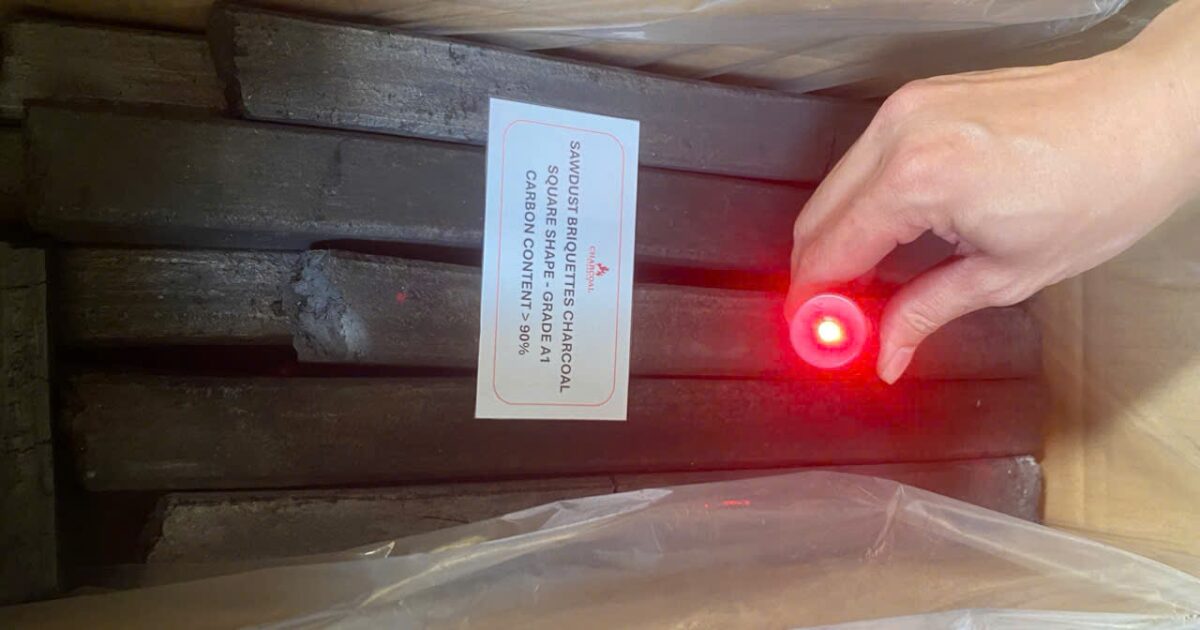
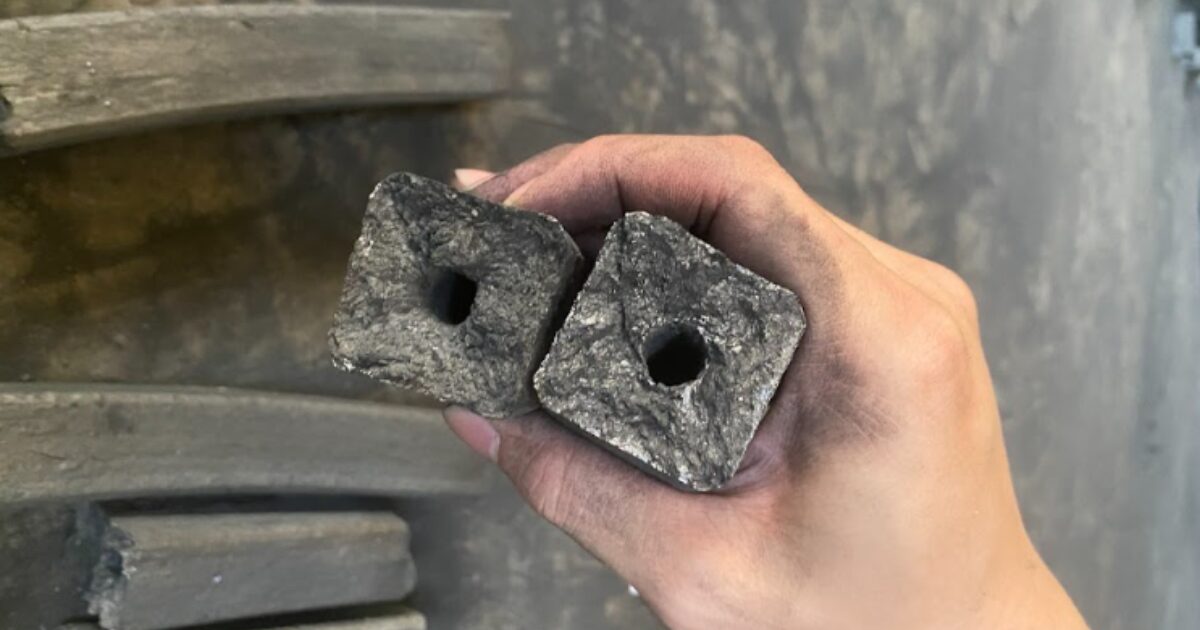
Ogatan is the Japanese term for compressed sawdust charcoal with a hollow core. The hollow core is what gives the briquette its airflow and its long, even burn. At The Charcoal Co. the two standard shapes are the square Ogatan briquette and the hexagonal Ogatan briquette, both produced from hardwood sawdust with no binder and no coal additive.
Buyers new to this product often ask what separates it from a pressed briquette sold in supermarkets. Density and residue. A well made Ogatan briquette leaves roughly 2 to 3 percent ash by weight. A starch bound supermarket briquette can leave four times that. Over a year, a yakiniku chain burning 900 kilograms a month feels that difference in cleaning labour, not just in fuel cost.
What is the minimum order quantity?
The practical minimum for an ogatan charcoal wholesale contract is one full 20 foot container, roughly 18 to 20 tonnes depending on pack format. Below that, freight per kilogram rises to the point where the wholesale price advantage disappears. Some buyers start with a mixed pallet trial of 500 to 1,000 kilograms, and that is a reasonable way to test the product with an end customer before committing.
Pack format drives the tonnage more than most buyers expect. A 10 kilogram carton stacks tighter than a 5 kilogram printed retail bag, so the same container holds a different net weight depending on what the label programme requires. The table below shows the formats we quote most often.
| Pack format | Net weight per unit | Units per pallet | Typical net weight per 20ft |
|---|---|---|---|
| Bulk carton, unprinted | 10 kg | 100 | 19.5 to 20 tonnes |
| Woven bag, unprinted | 20 kg | 50 | 20 tonnes |
| Printed retail bag | 5 kg | 180 | 17.5 to 18 tonnes |
| Printed retail box | 3 kg | 280 | 16 to 17 tonnes |
Read that table as a planning tool, not a promise. Exact figures move with carton dimensions and with the pallet standard used in the destination market. Ask any ogatan charcoal wholesale supplier to confirm net weight per shipment in writing before you build a landed cost model on it.
How is ogatan charcoal wholesale pricing structured?
Ogatan charcoal wholesale pricing sits on three variables: annual committed volume, pack format, and payment terms. Volume is the largest lever. A buyer committing 240 tonnes a year is planning production capacity for us, and that predictability is worth a real discount against a one off order of the same size.
- Tier 1, single shipment, no annual commitment: list price.
- Tier 2, 4 to 6 shipments a year: roughly 4 to 7 percent below list.
- Tier 3, monthly shipments with a signed annual volume: roughly 8 to 12 percent below list.
- Private label programmes carry a one time plate and film cost, then price as the matching tier.
Printing changes the number too. A private label order adds artwork setup, film, and a higher reject rate on the first run. If retail packaging is part of the plan, read our note on private label charcoal and OEM packaging before you lock the ogatan charcoal wholesale price, because the packaging decision is usually made too late to be cheap.
Raw material seasonality matters as well. Sawdust supply in northern Vietnam tightens during the rainy months, and drying cost rises with it. Contracts written with a fixed price for twelve months either carry that risk in the price or include a review clause. Ask which one you are signing.
How long does production take?
Standard ogatan charcoal wholesale lead time is 18 to 25 days for unprinted formats once the deposit clears, and 30 to 40 days when printed packaging is involved. Carbonisation itself is slow. A kiln cycle runs several days, and rushing it is exactly how ash content climbs and how the briquette starts producing smoke it should not produce.
The step buyers underestimate is drying. Sawdust arriving at 30 percent moisture has to come down before extrusion, and in humid weather that adds days. Our production process page sets out the sequence. Any ogatan charcoal wholesale quotation that promises ten day lead time in August is quoting stock, not production, and stock quality depends on how it was stored.
Which documents should come with the shipment?
A complete ogatan charcoal wholesale delivery arrives with a document set, and the buyer should name that set in the contract rather than assume it. At minimum, request a batch test report, a certificate of origin, a packing list tied to batch numbers, and the chain of custody claim if you are buying certified material.
- Batch test report: fixed carbon, ash, moisture, volatile matter, calorific value.
- Certificate of origin issued against the actual production batch.
- Packing list showing net and gross weight per pallet.
- FSC chain of custody claim on the invoice when certified material is ordered.
- Photographs of the loaded pallets before the doors close.
Two of those lines carry most of the value. The batch test report tells you whether the lot matches the specification you paid for, and our guide to charcoal ash content testing explains how to read it without a laboratory. The FSC claim matters for buyers selling into the European Union or to retail chains with sourcing policies, and the detail sits in our FSC certified charcoal supply article.
What mistakes show up in first wholesale orders?
The most expensive mistake in a first ogatan charcoal wholesale order is accepting a specification written as adjectives. “Premium grade, low ash, long burning” is not a specification. It gives the buyer nothing to reject a lot against. Numbers with tolerances do: ash 3 percent maximum, moisture 6 percent maximum, fixed carbon 80 percent minimum, length 200 millimetres plus or minus 10.
The second mistake is skipping the sample stage to save two weeks. A 20 kilogram sample burned by the end customer in their own equipment answers questions that no data sheet answers, and for high volume grill kitchens where briquette geometry affects handling.
The third is paying the balance before inspection. Standard terms are 30 percent deposit and 70 percent against documents, and the inspection window belongs inside that structure. Our payment and delivery terms page sets out how we handle it.
How do you compare two ogatan charcoal wholesale suppliers?
Compare on evidence a trading desk cannot produce, because an ogatan charcoal wholesale programme depends on production control rather than on sales talk. Ask for the kiln count and monthly output. Ask for a dated photograph of the current production line. Ask which mills supply the sawdust and whether that supply is contracted or bought on the spot market. A factory answers those questions in a paragraph. A reseller changes the subject to price.
Then compare consistency rather than a single best result. Request test reports from three different months. If ash content moves from 2.1 to 4.8 percent across those reports, the supplier does not control the input, and your end customer will notice by the third delivery. That single check has saved more ogatan charcoal wholesale programmes than any price negotiation.
Independent reference material on briquette manufacturing is worth a read before the first call, and the overview on briquette production is a reasonable neutral starting point.
How do you forecast volume for an ogatan charcoal wholesale contract?
Forecast an ogatan charcoal wholesale volume from the end customer burn rate, not from warehouse space. A single yakiniku table burning through a service uses roughly 1.2 to 1.8 kilograms of Ogatan per evening. A 30 table restaurant open 26 days a month lands somewhere between 950 and 1,400 kilograms. Multiply by the number of outlets and you have a monthly figure worth writing into an ogatan charcoal wholesale schedule.
Retail behaves differently. Bagged charcoal sells in a summer curve in Europe and North America, with a peak between May and August, and a much flatter curve in the Gulf where demand holds through the cooler months. A buyer serving both channels usually splits the annual commitment into four unequal releases rather than twelve equal ones.
Add a buffer for transit and for slow moving stock. Most distributors we work with hold six to eight weeks of cover. Below four weeks, a single delayed sailing empties the shelf. Above twelve weeks, storage cost and moisture pickup start eating the margin the volume tier just earned.
| Channel | Typical monthly burn | Suggested cover | Pack format |
|---|---|---|---|
| Yakiniku or Korean BBQ chain, 10 outlets | 9 to 14 tonnes | 6 weeks | 10 kg carton |
| Retail distributor, summer market | 20 to 60 tonnes seasonal | 10 weeks pre season | 5 kg printed bag |
| Industrial or catering supplier | 15 to 25 tonnes | 6 weeks | 20 kg woven bag |
What should the contract say about rejected lots?
A claims clause is the cheapest insurance in an ogatan charcoal wholesale agreement, and it is the clause most often left out. It needs three elements: the test method used to judge the lot, the window in which the buyer must raise the claim, and the remedy. Without all three, a dispute becomes a negotiation about who sounds more reasonable.
Name the method. Ash and moisture measured by a recognised laboratory procedure on a composite sample drawn from at least ten cartons across the lot. A single bag pulled from the container door is not representative and will not survive scrutiny from either side.
Set the window at 14 to 21 days from arrival. Charcoal picks up moisture in storage, so a claim raised four months after delivery cannot separate a production fault from a warehouse fault. Set the remedy as replacement tonnage on the next shipment rather than a cash refund, which keeps the ogatan charcoal wholesale relationship running while the problem gets fixed.
One more line worth adding: retained samples. The factory keeps a sealed 2 kilogram sample of every batch for six months, and so should the buyer. When a claim arrives, both sides test the same material instead of arguing about which sample is real.
Why move from spot buying to an ogatan charcoal wholesale contract?
Spot buying looks flexible until the third quarter. Prices for sawdust based briquettes move with raw material supply and with freight, and a buyer without a contract absorbs both swings at the worst moment, which is usually the week the end customer runs out. An ogatan charcoal wholesale contract fixes the specification and the release schedule, and it puts the buyer ahead of walk in orders when kiln capacity is tight.
There is a quality argument as well. Contracted material is produced against a named specification with retained samples, and the factory plans sawdust intake for it. Spot material is whatever finished last week. Two buyers can pay a similar price per tonne and receive products that behave differently in the same grill.
The switch does not have to be dramatic. Most distributors move in stages: one trial shipment, two contracted shipments, then an annual ogatan charcoal wholesale volume with quarterly releases. By the third step the buyer has enough test reports to know exactly what the tolerance band looks like in practice.
Frequently asked questions
Can an ogatan charcoal wholesale order mix square and hexagonal briquettes?
Yes. Mixed ogatan charcoal wholesale loads are common, and the usual split is 60 percent hexagonal for grill kitchens and 40 percent square for retail packs. Each shape is packed and labelled separately so the batch test report stays traceable to one shape.
What is a realistic first order for a new distributor?
One 20 foot container of ogatan charcoal wholesale material in unprinted cartons, with a 500 kilogram sample shipment two months earlier. That sequence lets the end customer test the product while the main order is still in the planning stage.
Does the price include packaging design work?
Artwork adaptation to the print template is included. Original brand design is not. Buyers usually supply print ready files, and the factory returns a dieline and a printed proof before the run.
How long can the briquettes be stored before quality drops?
Twelve months in a dry warehouse with pallets off the floor, which is why ogatan charcoal wholesale buyers should plan cover in weeks rather than quarters. Charcoal absorbs moisture from the air, and a lot stored in a humid open shed for six months will light slower and smoke more than the same lot kept sealed.
Conclusion
Write the numbers into the contract. Ash ceiling, moisture ceiling, fixed carbon floor, dimensional tolerance, net weight per shipment, and the document set that travels with the goods. Those six lines decide whether an ogatan charcoal wholesale programme survives its second year, and they cost nothing to add before the first order.
The Charcoal Co. produces square and hexagonal Ogatan briquettes at our factory in Hoa Binh Province, Vietnam, with FSC certified material available and monthly capacity for repeat container programmes. To discuss specification, tier pricing and lead time for an ogatan charcoal wholesale order, call (+84) 338 218 168 (Ms. Elly) or request a quotation here.