
A Korean barbecue group opened its eleventh outlet and ordered fuel on the same standing order as the other ten. Within five weeks the new site had run out twice and was buying retail bags at four times the contract price. The outlet had 22 table grills against an average of 14, and it ran a lunch service the others did not. Nobody had recalculated. Getting charcoal consumption wrong by 40 percent is normal when the number is inherited rather than measured.
Charcoal consumption is usually between 2 and 5 percent of food cost in a grill kitchen, small enough to escape attention and large enough that a 20 percent error is real money. It is also the input most likely to run out on a Saturday night. A purchasing team that can forecast charcoal consumption to within 10 percent negotiates better contracts, holds less stock, and stops paying spot prices for emergency deliveries.
What drives charcoal consumption in a commercial kitchen?
Charcoal consumption moves on five variables, and only two of them are about the fuel. Purchasing teams tend to focus on the fuel and underweight the equipment, which is why supplier changes often fail to produce the savings expected.
- Number of active grill positions and how many run at once during peak service.
- Service hours per day, including the pre service lighting period.
- Grill type and volume, since an open table grill loses far more heat than an enclosed one.
- Refill discipline, meaning whether staff top up continuously or rebuild the bed.
- Fuel density and burn time per kilogram, the only two fuel properties that matter here.
The lighting period is the variable most often ignored. Bringing a bed to cooking temperature consumes fuel before a single order arrives, and a kitchen lighting twice a day for lunch and dinner carries that cost twice. On a 14 grill site this alone can account for 15 percent of monthly charcoal consumption.
Refill discipline is the second hidden variable. Staff who add a handful every 20 minutes keep the bed at working temperature and use less fuel than staff who let it die and rebuild. The difference between a well drilled kitchen and a careless one on identical equipment runs between 12 and 25 percent, which is larger than the difference between most fuel grades.
How is charcoal consumption calculated from grill hours?
Charcoal consumption starts with a burn rate per grill hour, multiplied by active grill hours, then add the lighting allowance. The arithmetic is simple. The value sits in using a burn rate measured on the actual equipment rather than a figure taken from a supplier brochure.
| Grill type | Burn rate per hour | Lighting allowance per session | Note |
|---|---|---|---|
| Table top yakiniku grill | 0.35 to 0.55 kg | 0.4 kg | Small bed, frequent top ups |
| Korean BBQ table with extraction | 0.45 to 0.70 kg | 0.5 kg | Extraction pulls air and raises rate |
| Open kitchen grill 1 metre | 2.0 to 3.5 kg | 2.5 kg | Deep bed, long service |
| Robata or yakitori grill | 1.2 to 2.0 kg | 1.5 kg | Narrow bed, continuous burn |
| Rotisserie or oven charcoal | 1.5 to 2.5 kg | 2.0 kg | Enclosed, most efficient per hour |
| Kebab or shawarma vertical grill | 2.0 to 3.0 kg | 2.0 kg | Unbroken burn, ash builds at the base |
The working formula is straightforward. Monthly charcoal consumption in kilograms equals grill positions multiplied by average active hours per day, multiplied by burn rate, plus lighting allowance multiplied by sessions per day, all multiplied by trading days per month.
Take the 22 grill outlet from the opening example. Twenty two tables, an average of 5.5 active hours each, a burn rate of 0.55 kilograms per hour, two lighting sessions a day at 0.5 kilograms per grill, and 28 trading days. That gives 22 times 5.5 times 0.55, which is 66.6 kilograms per day, plus 22 kilograms of lighting fuel, for 88.6 kilograms daily and roughly 2,480 kilograms a month. The site had been ordering 1,600.
How do you measure a real burn rate on site?
Measure charcoal consumption over seven trading days with a scale and a tally sheet. A measured burn rate beats any published figure, because it captures the equipment, the staff habits and the menu at the same time.
- Weigh the opening stock of charcoal on day one, to the nearest kilogram.
- Record every delivery received during the period.
- Record grill positions active and hours run each day on a simple tally sheet.
- Weigh closing stock on day seven at the same time of day.
- Charcoal consumption for the week equals opening stock plus deliveries minus closing stock.
- Divide by total active grill hours to get a burn rate per grill hour.
Run the charcoal consumption exercise in a normal week, not a promotional one, and repeat it in a different season before treating the result as a baseline. Kitchens in humid months use more fuel because ambient moisture affects both lighting time and the charcoal itself, an effect described in our guide to charcoal moisture content limits.
Weigh, do not count bags. Bag weights drift, cartons get opened and part used, and a count of bags carries an error of several percent before anything else is measured. A 150 kilogram platform scale in the store room costs under 200 US dollars and pays for itself in the first month of accurate charcoal consumption data.
How does briquette quality change charcoal consumption?
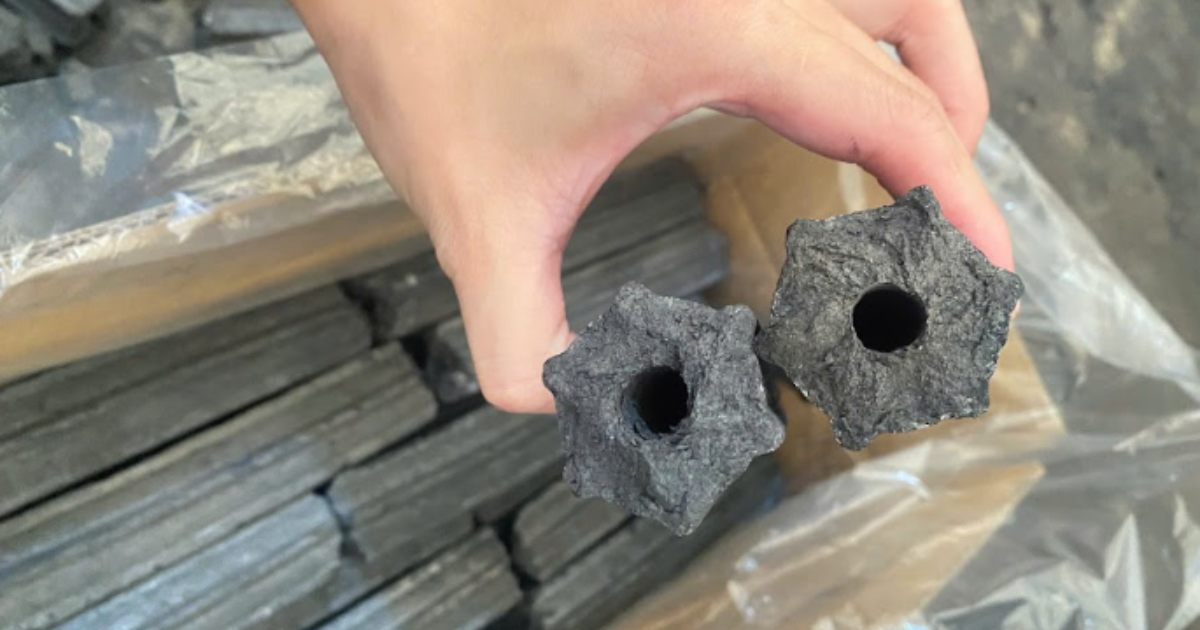
Charcoal consumption responds to three properties: density, fixed carbon and moisture. Together they explain most of the difference between two fuels that look identical in a bag, and they are the reason a cheaper tonne is sometimes a more expensive year.
| Property | Typical Ogatan figure | Effect on usage | Cost impact at 2,400 kg monthly |
|---|---|---|---|
| Density | 1.0 to 1.2 g per cm3 | Higher density burns longer per kilogram | Up to 8 percent volume difference |
| Fixed carbon | 75 to 85 percent | More usable energy per kilogram | 5 to 10 percent |
| Moisture | 3 to 6 percent | Water absorbs heat before cooking begins | 3 to 7 percent |
| Ash | 2 to 3 percent | Ash blocks airflow, staff add more fuel | 4 to 9 percent |
| Fines in the carton | Under 2 percent | Fragments unusable in most grills | Direct loss, 1 to 6 percent |
Stacked together, the gap between a controlled binder free briquette and a cheap bound one reaches 20 to 30 percent in real charcoal consumption. A kitchen using 2,400 kilograms a month at 620 dollars per tonne spends 1,488 dollars. The same kitchen on material burning 25 percent faster needs 3,000 kilograms, and even at 560 dollars per tonne that is 1,680 dollars.
This is why fuel comparisons run on delivered price per tonne mislead so consistently. Convert to cost per grill hour instead. Divide the delivered price per kilogram by the hours a kilogram supports on the actual equipment, and the ranking of two suppliers frequently reverses. The same logic applied to written offers is set out in our guide to reading a charcoal quotation.
Where does charcoal consumption leak without anyone noticing?
Four places, and none of them appear in a purchase ledger. A kitchen hitting its forecast on paper while running short in practice is usually losing fuel to one of these rather than using more of it.
The first is fines. Fragments under 15 millimetres fall through most grill grates and are swept out unburned. A carton arriving with 6 percent fines is 6 percent of the invoice that never reaches a cooking surface, and it shows in charcoal consumption as a burn rate that looks worse than the fuel deserves.
The second is overnight burn out. Beds left glowing after service consume fuel for hours with nobody cooking. Closing the air intakes and covering the bed recovers a usable amount of charcoal for the next lighting, and kitchens that adopt the habit report 5 to 8 percent lower monthly usage.
The third is stock shrinkage. Charcoal is portable, useful at home, and rarely counted. Sites that begin weighing weekly frequently find their measured charcoal consumption drops without any operational change, which is informative in itself.
The fourth is bag weight drift. A bag declared at 10 kilograms delivering 9.6 kilograms produces a 4 percent error in every calculation built on bag counts. Weight declaration rules and the tolerances behind them are covered in our note on charcoal label requirements.
What safety stock and reorder point should a kitchen hold?
Enough charcoal consumption cover for the delivery lead time plus one week, and no more than four weeks in total unless storage is dry and secure. Charcoal does not spoil, but it absorbs moisture and it occupies space that usually has a better use.
| Supply route | Lead time | Safety stock | Reorder point |
|---|---|---|---|
| Local distributor stock | 2 to 4 days | 1 week | At 10 days cover |
| Regional wholesaler | 7 to 10 days | 10 days | At 3 weeks cover |
| Direct import, container | 40 to 55 days | 4 weeks | At 10 weeks cover |
| Mixed, contract plus local top up | 3 days for top up | 10 days | At 3 weeks cover |
Direct importing changes the arithmetic completely. A single group importing its own containers needs ten weeks of visibility on charcoal consumption rather than three, which is why chains usually move to direct supply only once they have twelve months of measured usage data across sites.
Storage conditions cap the sensible buffer. Cartons on pallets in a dry room hold condition for months. The same cartons on a concrete floor in a humid back corridor gain moisture and shed fines, and the stock a manager thought was insurance turns into a fuel that lights slowly. Contract structures that balance volume against delivery frequency are covered in our note on restaurant charcoal supply contracts.
How should a multi site group forecast charcoal consumption?
Forecast charcoal consumption per site, using grill count and trading hours, then aggregate. Averaging across sites is the error that started this article, and it grows worse as a group adds formats.
Build a simple table with one row per outlet holding grill positions, average active hours, sessions per day, trading days and a measured burn rate. Multiply through and sum. A group of ten outlets can maintain this in a spreadsheet, and updating it after any equipment change takes minutes. Charcoal consumption forecasts built this way typically land within 8 percent of actual usage.
Seasonality then sits on top of charcoal consumption as a multiplier per site rather than per group. Outdoor terrace seating swings usage far more than indoor covers, so two outlets in the same city can have opposite seasonal curves. Apply a monthly index to each site from its own twelve month history rather than to the group total.
Menu changes deserve a manual review. Adding a single high volume grilled item can lift charcoal consumption at a site by 10 to 15 percent without any change in covers, and it is the kind of shift a purely historical forecast will not see coming until the stock runs short.
How does charcoal consumption feed the annual purchase volume?
Multiply the forecast monthly charcoal consumption by twelve, add the seasonal peak buffer, and round to whole containers if importing directly. That number is the one that unlocks a supply tier rather than a spot price.
A ten outlet group with charcoal consumption averaging 1,900 kilograms per site per month consumes 228 tonnes a year, which is roughly ten 40 foot containers of Ogatan. That volume sits in a meaningfully better pricing tier than the same group buying monthly from a wholesaler, and the difference commonly runs 9 to 13 percent before freight.
Committing to that volume requires confidence in the charcoal consumption figure, which is the practical reason to measure before negotiating. A group presenting a twelve month schedule with a stated tolerance holds a stronger position than one asking for a discount on an estimate, and the sample and specification steps that precede a contract are set out in our note on the charcoal sample order process.
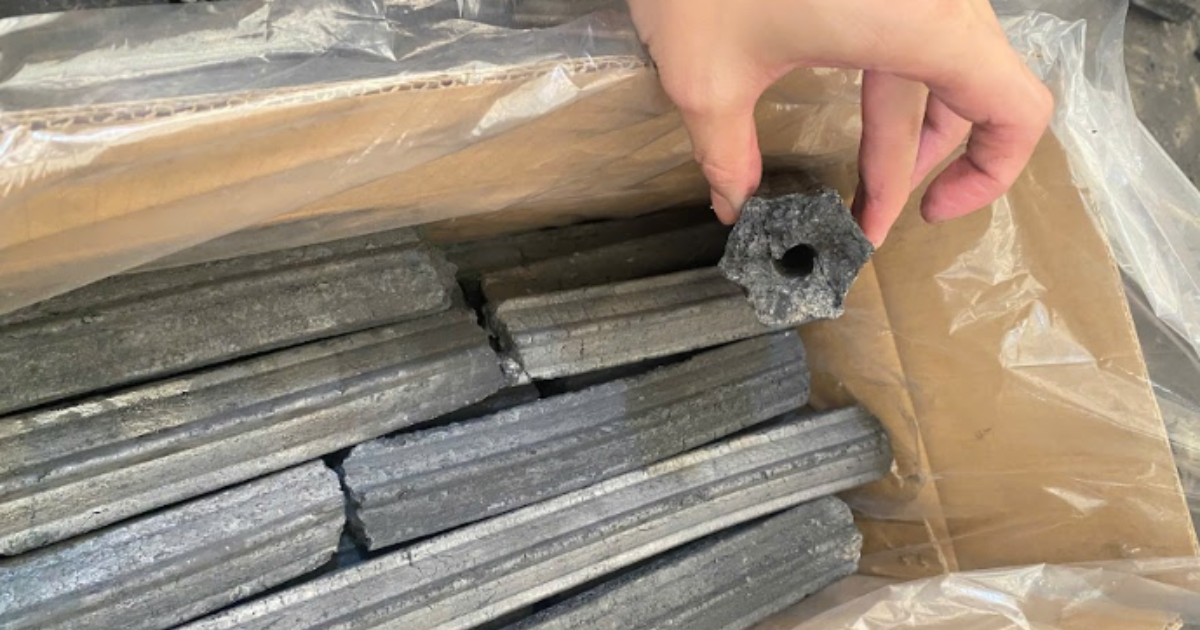
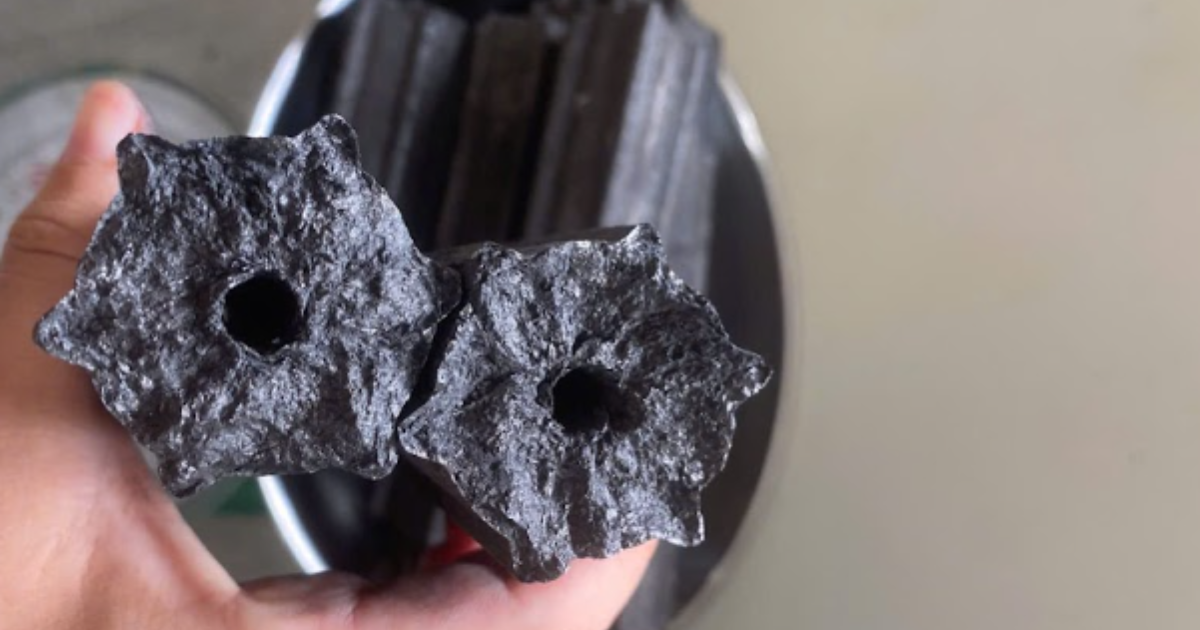
Product choice belongs in the same decision. Hexagonal briquettes with a centre hole light faster and suit table grills, while solid square briquettes hold longer in deep beds, and the two produce measurably different charcoal consumption on the same menu. Specifications for hexagonal sawdust charcoal and square sawdust charcoal show the dimensional differences. Independent background on the fuel properties involved is published by the Food and Agriculture Organization.
Frequently asked questions
How much charcoal does one restaurant grill use per day?
Charcoal consumption runs 2 to 5 kilograms for a table grill on a single dinner service, and 12 to 25 kilograms for a one metre open kitchen grill running lunch and dinner. Measure on site, because equipment and staff habits move these figures more than the fuel does.
Does a denser briquette always reduce charcoal consumption?
In deep beds and long services, yes, usage falls measurably. On small table grills the effect is smaller, because those grills are refilled by handful rather than by weight and the limiting factor is lighting time rather than burn duration.
How often should a forecast be rebuilt?
Rebuild a charcoal consumption forecast twice a year for a stable site, and immediately after any change in grill count, trading hours or menu. A forecast older than a year on a growing group is usually wrong by more than 15 percent.
Should kebab and shawarma outlets use the same method?
The method is the same but the unit changes from grill hours to vertical grill hours, and the burn runs unbroken rather than in service peaks. Ash build up at the base is the dominant variable, so a tighter ash limit lowers usage more than any change in burn rate.
What is a reasonable target for fuel cost per cover?
Most charcoal grill restaurants land between 0.10 and 0.35 US dollars per cover depending on format. Tracking this figure monthly catches equipment problems and staff habit drift faster than tracking total spend.
Conclusion
Weigh the stock for one week, count the grill hours, and divide. That single exercise replaces an inherited number with a measured one and usually moves the forecast by more than any change of supplier would. Then convert every offer to a cost per grill hour rather than a price per tonne, because charcoal consumption and price only mean something together. A purchasing team holding both numbers can commit to annual volume with confidence and buy at a tier the spot market will never match.
The Charcoal Co. manufactures binder free square and hexagonal Ogatan briquettes at our factory in Cong Village, Tan Lac Commune, Hoa Binh Province, Vietnam, with density, fixed carbon and burn time data available for usage modelling. For a specification sheet, a trial pallet, or a quotation against your annual volume, call (+84) 338 218 168 (Ms. Elly) or contact our team here.